From late November to early December, under the arrangement of the “Ma Ying-jeou Foundation,” teachers and students from multiple universities in mainland China, along with Olympic champions, visited Taiwan for an exchange. During their visit, they toured several universities and explored various cultural and natural landmarks across Taiwan.
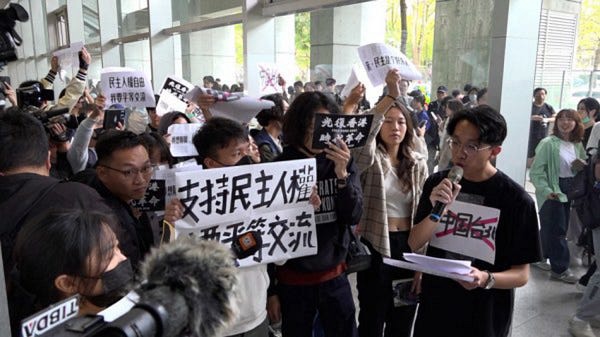
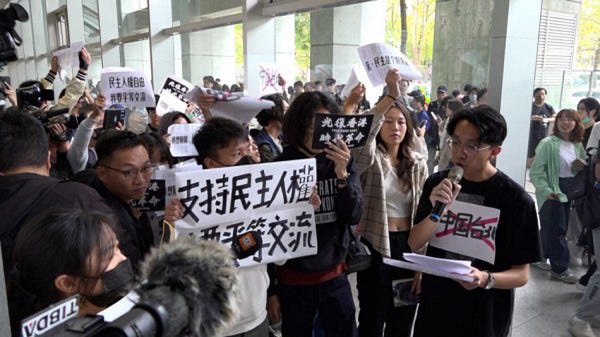
However, during the visit, the delegation encountered protests from some Taiwanese citizens and students. Controversy escalated when Song Siyao, a mainland student from Fudan University, referred to the recently crowned baseball world champions, the “Chinese Taipei Team”/“Taiwan Team,” as the “China Taipei Team.” This remark sparked dissatisfaction from the Democratic Progressive Party (DPP) government and parts of the Taiwanese public, leading to intensified protests. When the mainland delegation passed by, many protesters held signs with slogans such as “This is not China Taipei,” “Chinese students come to learn about democracy,” “Taiwan Independence,” “Xinjiang Concentration Camps,” “Tibetan Human Rights,” “Democratization of China,” “June Fourth Tiananmen,” “White Paper Revolution,” and “Gender Equality.” They also chanted these messages. The mainland delegation, including its youth members, generally kept their heads down, avoided eye contact, remained silent, and quickly passed through the protesting crowd.
During their nine-day stay in Taiwan, the delegation faced protestors holding signs and shouting slogans at nearly every public event they attended. The teachers and students in the group offered no verbal responses, refused to accept flyers handed to them by protestors, and weathered the waves of protests in almost complete silence. In response to the protests, many mainland students appeared visibly evasive, flustered, or embarrassed—reactions that were captured on camera and mocked by Taiwanese politicians from the Green Camp and other opponents.
This scenario is not an isolated case. Whether during past cross-strait exchanges involving mainland Chinese delegations (including officials and private citizens, such as the 2008 visit by Chen Yunlin, then president of the Association for Relations Across the Taiwan Straits) being attacked in Taiwan, or Chinese international students in Western countries facing political protests during official or private events, mainland Chinese participants often respond with silence. This is especially evident when the opposition raises sensitive political topics or taboo terms related to mainland China, which the students tend to avoid at all costs. On many sensitive yet significant issues, mainland Chinese students have been notably “speechless.”
Mainland Chinese students’ tendency to avoid and remain “speechless” when confronted with sensitive political topics and protests stems from various reasons. On one hand, the unique political system and censorship mechanisms in mainland China create significant uncertainty and risks when addressing these issues. Out of concerns for their personal safety and future prospects, mainland students often choose to remain silent and avoid discussing topics that could potentially cause them trouble.
More fundamentally, however, mainland Chinese students—shaped by their political system and environment—have lost the intellectual, ethical, and behavioral capacity to actively engage with, think critically about, and appropriately respond to sensitive yet important political and international issues.
In recent decades, including among young students, people in mainland China have generally adopted an attitude of indifference, silence, and avoidance toward politically charged or ideologically contentious issues. While there are some individuals on the internet who engage in “keyboard politics” (online discussions about political topics), these individuals remain a small minority passionate about political and international issues. Even so, “keyboard politics” is still subject to restrictions, such as post deletions and account bans. Moreover, such discussions almost exclusively take place anonymously online, without any public expression in offline settings such as schools, workplaces, or everyday life, let alone through demonstrations or other political activities. For the vast majority of Chinese students and young people, their lives revolve around academic studies, pursuing careers, and earning money, or simply enjoying a peaceful and carefree life. They steer clear of political matters, avoid sensitive topics, and adopt the mindset of “sophisticated self-interest.”
China’s educational system also tends to shy away from engaging in critical, multi-faceted discussions on controversial topics such as democracy versus authoritarianism, unification versus independence, ethnic relations, gender inequality and equal rights, freedom of speech, and press freedom. These topics are rarely taught in depth, and when they are mentioned, they are typically summarized and finalized with politically correct platitudes (e.g., “the Chinese national community,” “people on both sides of the Taiwan Strait are one family, bound by blood ties,” “the people’s democratic dictatorship,” or “the state respects and protects human rights/freedom”) that allow no dissent or debate. There is a notable lack of education in China in areas such as general knowledge, logic, and pluralistic thinking.
As a result, even if some mainland Chinese students are interested in controversial issues, they lack the means to systematically and effectively access relevant information or the ability to accurately understand the context and consequences, and to reasonably assess what is right or wrong. Even when the facts are on their side, they often struggle to articulate their points convincingly due to unfamiliarity with the complex rhetoric and rules grounded in universal values and widely accepted in international discourse. They lack knowledge of the subtle “strategies” embedded in modern democratic and civil systems and have difficulty countering opponents or gaining sympathy and support. Even when they have valid arguments, they either fail to present them or fail to do so in a persuasive and impactful manner.
It is thus no surprise that such mainland Chinese students struggle to respond to the critiques and challenges posed by Hong Kong, Taiwanese, or foreign students, who are more experienced with civic education, more familiar with “sensitive issues,” and more skilled at debate. Of course, there are also some mainland youths who are well-informed, understand the rules of democratic societies, and possess strong expression and debate skills. Yet, even they often choose to remain silent out of self-interest, unwilling to risk embroiling themselves in controversy, embodying a self-serving cynicism.
During the 2010s, a period marked by China’s rising national power and improving economic and social conditions, some pro-government, establishment-aligned, and nationalist mainland Chinese students were more vocal in debates with Hongkongers, Taiwanese, and foreigners. These individuals engaged in what they called “active expression” (such as the so-called “online crusades”), but their responses often consisted of repeating empty slogans like “upholding socialist core values,” posting internet memes, using sarcastic “political slang” from online discussions, or resorting to insults such as “NMSL” (a vulgar phrase). Such responses were intended to counter criticisms of the Chinese government and mainland China.
This type of expression is neither normal, effective, nor substantive political discourse. Instead, it fully reflects the lack of knowledge and impoverished language skills among many mainland Chinese youths, students, and netizens—from elites to ordinary people. Some Chinese students studying in Hong Kong, Taiwan, and Western countries engaged in irrational, thuggish behavior, including verbal abuse and physical assaults on dissenters. Such actions not only demonstrated a lack of civility and inability to engage in proper communication but also, in some cases, violated laws and regulations. These low-quality “expressions” tarnished China’s national image and brought shame and collateral damage to Chinese people globally.
In recent years, as China has faced internal and external challenges and been placed in a weaker position in international discourse, mainland Chinese youth, including students, have generally become far more subdued and silent (even those who previously actively opposed Taiwanese independence, countered perceived “insults to China,” or engaged in patriotic “online crusades”). Many have become completely “speechless,” even in discussions where they may have had valid points or could have clarified misunderstandings and complexities through debate. Topics such as racial discrimination and hateful actions targeting mainland Chinese in Hong Kong, Taiwan, Japan, or Western countries; China’s direction amid the global wave of conservative populism; cross-strait differences and disputes unrelated to political systems or unification; China’s policies in Xinjiang and Tibet; and other significant historical and political controversies are often met with silence from these individuals.
Some foreign universities have invited Chinese students to participate in debates on such issues, but these students often refuse, ignore the invitation, or merely attend as silent observers without contributing to the discussion. This “political apathy” is not confined to students—it is also prevalent among the broader Chinese public and the overseas Chinese diaspora. Even many Chinese immigrants who have acquired foreign citizenship, including Chinese students and citizens abroad, often exhibit indifference to politics and avoid engaging with controversial issues.
Based on my direct observations and indirect understanding, other ethnic and identity groups worldwide—whether White or Black, Christian, Muslim, or atheist, Indian or Arab, Iranian or Korean diaspora, as well as Taiwanese and overseas Hongkongers, Uyghurs, and Tibetans—actively engage in public discussions, including political debates, and speak out to represent their communities.
However, despite comprising more than one-sixth of the global population and a significant number of international students, mainland Chinese Han/Chinese diaspora individuals are often silent and “invisible.” When faced with controversial topics requiring them to express their positions or defend their interests, or when confronted with protests or contentious narratives, they either repeat official rhetoric with no independent viewpoint or remain silent. While these individuals are not entirely indifferent to their rights, they are more concerned with their personal matters and private spheres. They lack a sense of communal identity, love, and responsibility toward their compatriots, showing little interest in the “public affairs” or “public domain” of their ethnic group or nation. They are unwilling to defend collective interests or uphold the dignity of their community.
This has resulted in a severe lack of voices from mainland Chinese people—especially individual, grassroots voices that reflect the experiences, emotions, and demands of the public—on important international issues related to China (including mainland-Hong Kong and mainland-Taiwan issues). The silence of youth from prestigious mainland universities and elite professionals in various fields is particularly worrisome and potentially harmful, as it signifies the “loss of voice” from the nation’s core and the future of its people. A weak voice and a lack of discourse power inevitably lead to disadvantages for the country and its citizens in terms of rights, dignity, and interests, as well as the stigmatization and misunderstanding of the Chinese people by the international community. While there are many causes for these outcomes, the most direct reason is the “loss of voice” among mainland Chinese people, particularly young students, on major controversial topics. This stems from their lack of both the ability and the desire to express themselves, compounded by real-world constraints. (Of course, there are also radical anti-government individuals, including some students and young people, who take the misguided path of opposing China at every turn, indiscriminately hating their own country and people. This path is equally wrong, tragic, and shameful.)
At the same time, within mainland China, the public often experiences the same “loss of voice,” whether voluntarily or involuntarily, on domestic media and self-media platforms regarding internal events. This is a stark contrast to the public opinion environment of a decade or so ago, when traditional media and the internet, while restricted, still allowed for some degree of freedom and openness. The “loss of voice” among mainland Chinese people on international issues is closely related to this domestic silence, and the two phenomena overlap in time. Without normal education, free flow of information, freedom of speech, outspoken and fair media platforms, channels for expression, and a healthy environment for debate within the mainland, how could mainland Chinese people possibly engage actively and rationally in debates on disputes involving China and the outside world without being disadvantaged?
The recent protests against mainland students visiting Taiwan and the collective silence of these students are just one typical example—a tip of the iceberg—of the broader phenomenon of “loss of voice” among mainland Chinese students, youth, and the general public in both domestic and international discourse. Such a “loss of voice” is unacceptable. Silence and emotional withdrawal are not the states in which young people should exist; nor should a nation’s people collectively avoid discussing political matters, as this is not the demeanor of a true national community. This silence gravely undermines the discourse power, public presence, and value of the country, the nation, and each individual citizen in public spheres and media, and harms their real, tangible interests in countless ways.
I fully understand that much of this “loss of voice” and “political apathy” among Chinese people stems from the larger environment shaped over decades and that individuals should not be overly blamed. However, every person has agency and the ability to navigate within constraints. Everyone also has civic duties. This is especially true for those with higher social status, better family backgrounds, and greater knowledge—both mainland Chinese and overseas Chinese. These individuals clearly have more resources and conditions to speak out for their compatriots, and therefore bear a greater responsibility to advocate for the underprivileged. They cannot allow environmental constraints and repression to become excuses for complete silence (or for praising the system and covering up injustices). The darker and more oppressive the environment, the more precious and necessary it becomes to break the silence and speak out.
China’s system and various sectors of society should create an environment that encourages young people and the general public to actively discuss current affairs, bravely voice their opinions on controversial topics, and develop the capacity to confront and address sensitive issues on the international stage. Today’s China and its people should return to the open and vibrant intellectual atmosphere of the New Culture Movement and the May Fourth Movement a century ago, as well as the spirit of the Republic of China era and the 1980s—a time when diverse opinions flourished, when people cared deeply about national and social issues, and when citizens felt a sense of responsibility to speak out not only for themselves but also for their compatriots.
Most importantly, mainland Chinese youth, particularly university students, should “shoulder the rise and fall of the nation.” They should cultivate empathy and compassion for the working class, farmers, and other disadvantaged groups, embodying the spirit of “feeling others’ hunger as one’s own, and others’ drowning as one’s own crisis.” While taking their own circumstances and safety into account, they should strive to participate boldly in discussions of public affairs, engage in dialectical thinking on contentious issues, and, when necessary, express themselves independently and proactively.
Such young people in mainland China represent the country’s hope. A China with such youth will be a truly independent, free, prosperous, and strong nation.
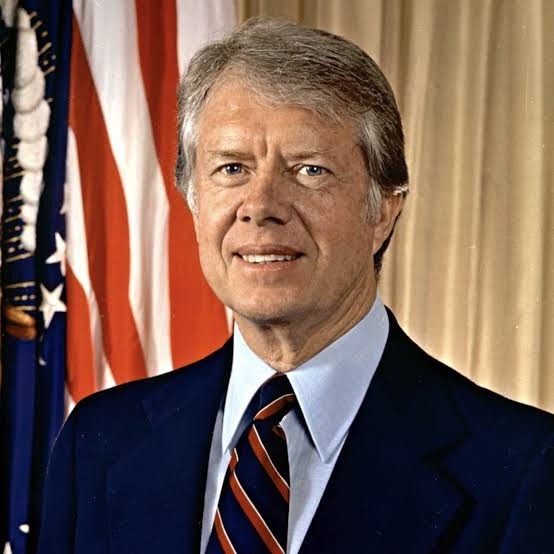
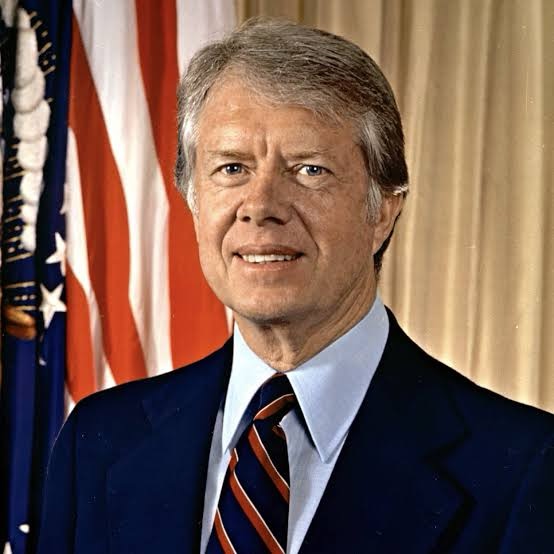
On December 29, just after Christmas and before the arrival of 2025, former U.S. President Jimmy Carter, who had reached the age of 100, passed away. Governments, political figures, media outlets, and countless others around the world expressed their condolences. Evaluations of him have been predominantly positive, though not without significant controversy.
Supporters praised Carter for prioritizing human rights during his presidency, for his approachable and humble demeanor, and for breaking away from the hegemonic style of U.S. politics. His achievements included establishing diplomatic relations with ideological rivals like China and returning sovereignty over the Panama Canal. After leaving office, Carter dedicated himself to international peace and humanitarian efforts until his death, further solidifying his reputation.
Critics, however, argue that Carter was ineffective in domestic policy and weak in diplomacy, citing examples like conceding too much to China and abandoning Iran’s pro-American Pahlavi regime, which paved the way for anti-American theocratic forces to rise to power.
Both the praise and criticism have their merits, depending on one’s values and perspective. Nevertheless, the vast majority of people (including many critics) acknowledge that Carter was a “good man.” By “good,” they mean kind, gentle, upright, and honest—qualities that are rare and precious in the cutthroat world of politics and the self-interest-driven international stage.
In American history, most presidents and politicians have been pragmatists, such as Harry S. Truman, Dwight Eisenhower, Richard Nixon, and the two Bushes(George Bush,Walker Bush) whose decisions were primarily based on U.S. interests rather than international justice or the intrinsic right and wrong of global disputes. Only a few presidents, like Woodrow Wilson, Franklin D. Roosevelt, and Barack Obama, could be considered relatively idealistic, though even their progressive foreign policies were ultimately aimed at expanding U.S. influence.
Carter, however, was a unique president whose domestic and foreign policies genuinely prioritized human rights, morality, justice, and fairness. During the Cold War, when ideological confrontation was intense, Carter actively sought to improve relations with communist states, reducing unnecessary hostility and breaking through the “Iron Curtain” and “Bamboo Curtain.” This, in itself, was a groundbreaking achievement. Meanwhile, after the Soviet invasion of Afghanistan in 1979, the Carter administration imposed a series of sanctions, proving that his approach to the Eastern bloc was not unconditional appeasement but rather based on principles of justice and humanitarianism.
Carter’s decision to abandon the Pahlavi regime in Iran and its subsequent consequences were unforeseen. Before coming to power, Ayatollah Khomeini promised to establish an inclusive new government, and while the Pahlavi regime had achieved some accomplishments, it was undeniably corrupt and autocratic. The transformation of Iran into a theocratic state with extreme anti-American sentiments was something neither Carter nor many other Westerners could have anticipated. The blame lies with Khomeini’s betrayal of his promises and the authoritarian violence of Iran’s theocratic forces, not with Carter.
As for Carter’s efforts to establish diplomatic relations and exchanges between the United States and the People’s Republic of China, this was undoubtedly a significant positive development from the perspectives of the Chinese government, the majority of its people, U.S. interests, and global benefits. The criticism that Carter “abandoned the Republic of China/Taiwan” or “enabled authoritarian China” does not reflect the full reality. Mainland China, with the largest population in the world and vast territory, is an unavoidable presence in international affairs. It was impossible for the U.S. government to indefinitely refuse diplomatic relations with it or continue to allow the Taiwan-based government to represent China. Even if reluctantly, U.S.-PRC normalization was inevitable. If Carter hadn’t facilitated this, someone else would have. For instance, even the right-wing Reagan administration maintained friendly relations with China later, partly to counter the Soviet Union.
Carter’s poor performance in domestic affairs was mainly due to the various issues left unresolved by several previous presidents, which could not be suddenly addressed, combined with the U.S. economic crisis and inflation cycle at the time. While Carter himself bore some responsibility, he cannot be solely blamed. Moreover, Carter prioritized public welfare and civil rights, such as steadfastly defending women’s right to abortion and supporting the rights of African Americans and other minority groups, effectively preserving the progress in equal rights achieved since the 1960s. Carter’s accomplishments in promoting civil rights and equality in the U.S. have been overlooked, as people focus only on the shortcomings of his economic policies and the challenges of inflation, which is a one-sided view.
What makes Carter even more admirable—and often overlooked—is his over four decades of activism after leaving office. He remained active in both American and international arenas, devoting himself to environmental protection, the rights of marginalized groups, cross-cultural exchanges, and education. He also nurtured numerous talents who made significant contributions to human rights and humanitarian causes.
For example, the Carter Center, co-founded by Carter and his wife, has become a leading organization dedicated to mediating conflicts between nations and within countries, reducing violence, promoting peace, combating infectious diseases, alleviating poverty, advancing education in underdeveloped regions, and protecting the rights of women and children. The center has also long been involved in U.S.-China relations, human rights in China, and Chinese social governance, playing an important role in China’s development and reform as well as in maintaining friendly U.S.-China ties.
The contributions made by Carter, his wife, and their colleagues were immense, delivered in a quiet and unassuming manner. Many Chinese political opposition figures favor politicians who loudly threaten the Chinese government, advocate for “decoupling and severing ties,” and are not only anti-CCP but also anti-China. They often ignore or even disparage Carter and others who planted seeds of human rights and hope in China, which is both shortsighted and narrow-minded. Promoting human rights and progress in China cannot rely on the biting north wind but rather on the gentle warmth of sunlight. Of course, specific policies and actions can be critiqued on a case-by-case basis, and the pros and cons of engagement policies with authoritarian regimes are open for debate. However, Carter’s decades-long efforts to promote human rights and improve livelihoods in impoverished regions—both in China and worldwide—are overall highly commendable.
Compared to years past, today’s world is marked by greater divisions. Nationalism, populism, xenophobia, and isolationism are on the rise in many countries. Politicians are increasingly focused on their own interests and the self-interest of their nations, while international conflicts and zero-sum games are becoming more frequent. To win or protect their interests, people often resort to lies and unscrupulous tactics, discarding morality and integrity as if they were worthless. Recent developments in U.S. politics, particularly Trump’s two presidential victories and the escalating political infighting between Democrats and Republicans, have dimmed America’s image as a “beacon of light.”
Against this backdrop, Carter’s domestic and foreign policies, which embodied the spirit of American idealism, are even more worthy of remembrance. Carter’s political qualities and practices, such as his adherence to political ethics, opposition to war and authoritarianism, and care for the disadvantaged, deserve attention and preservation.
Admittedly, the author is not optimistic about the future of China, the United States, or the world at large. It seems unlikely that America will see another politician as virtuous and good-hearted as Carter. Carter may well be the final chapter of America’s “idealistic politics.” Yet, despite the challenges, people must retain some degree of faith and strive to make the world a slightly better place.
No matter how great a figure may be, all must eventually pass away. But while life is finite, the soul is immortal, and the legacies left behind can continue to benefit future generations. As Mr. Carter leaves us, those who, amidst today’s turbulent and dark times, still dream, still believe in truth, goodness, and beauty, and still hold that the world can achieve peace, progress, fairness, and justice, must press forward with determination. They must carry on the ideals and spirit of the departed. This is the best way to honor Carter and all those who have dedicated their lives to peace, democracy, and progress but passed away before realizing their ambitions.

 王庆民政治评论