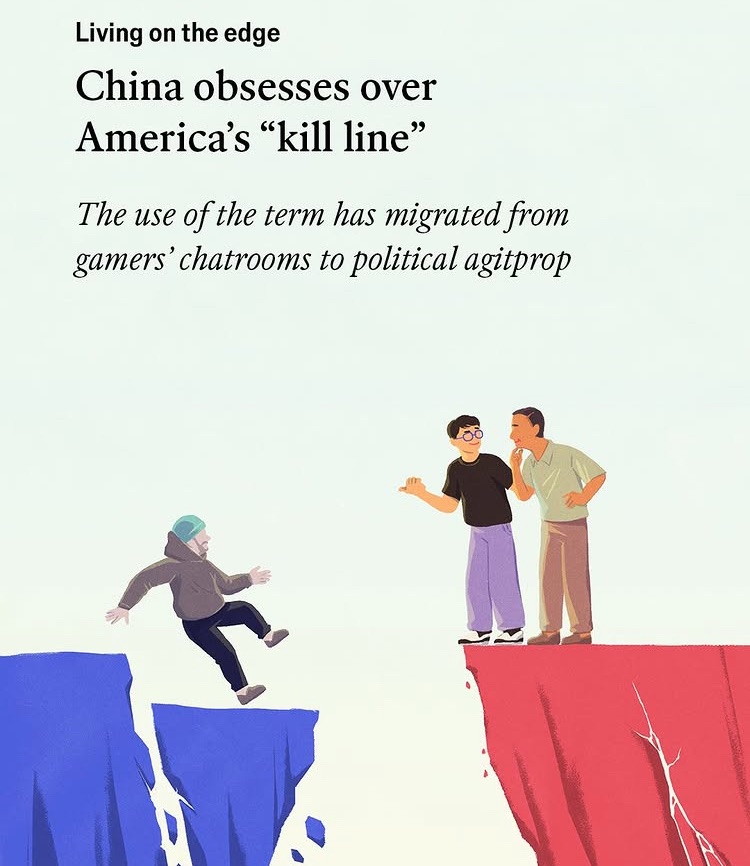
Over the past month, the term “kill line”(斩杀线) has sparked heated discussion across the Chinese internet. This term, originally derived from gaming jargon and adopted by Chinese influencers to describe what they portray as Americans’ lack of social protection and vulnerability, has become a popular talking point among supporters of China’s system and model to disparage the United States and, by contrast, to praise China as superior to the West. The New York Times and The Economist, among other media outlets, have also reported on the Chinese-language public debate surrounding the widely discussed U.S. “kill line” issue.
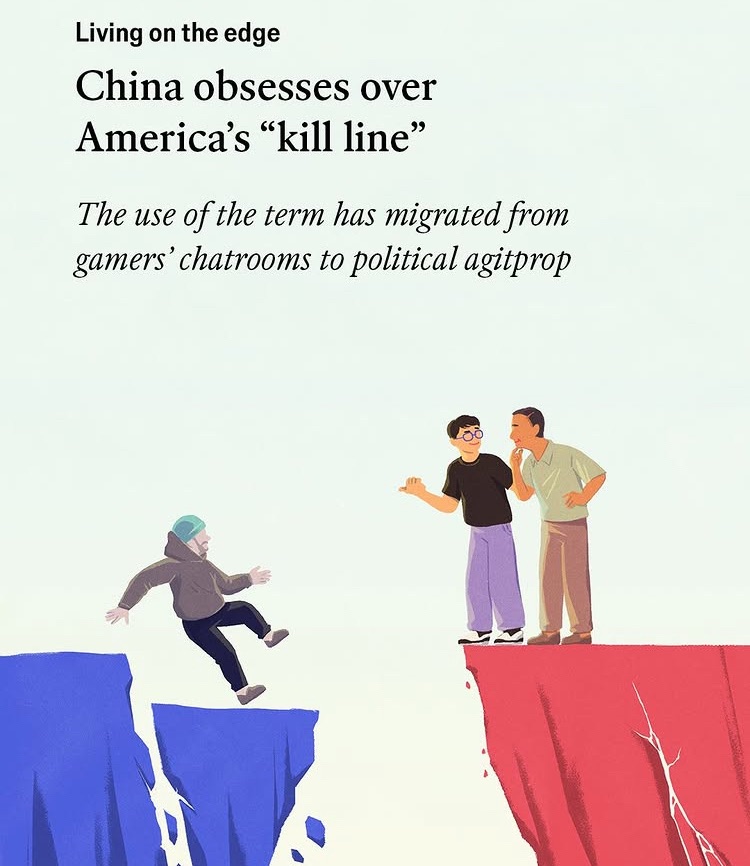
The “kill line” is also another round of hype surrounding the “win-ism”(赢学) that has flourished in Chinese public discourse in recent years. So-called “win-ism” refers to the practice of praising China’s achievements in areas such as the economy, infrastructure, technology, healthcare, and education, while simultaneously exaggerating and denigrating the shortcomings and weaknesses of foreign countries, especially Europe and the United States, in order to demonstrate that China’s system and model are superior to the West and to argue that China has “won.”
As Chinese scholars with official backgrounds such as Chen Ping(陈平) , Zhang Weiwei(张维为) , and Shen Yi(沈逸) have claimed, “2,000 renminbi in China has greater purchasing power than 3,000 U.S. dollars in the United States,” “speech in China is freer than in the West,” “Chinese farmers eat better than the middle class in New York,” and “South Koreans cannot afford to eat meat.”
Although these “win-ism” statements are not entirely without basis, they are clearly one-sided and run counter to common sense. They magnify the flaws of foreign countries while covering up China’s own problems.
For example, regarding prices and purchasing power in China and the United States, although prices in the United States are indeed higher, when income and prices are considered together, the average standard of living in the United States remains significantly higher than in China. Comparisons of diet cannot ignore differences in quality and eating habits. And Western restrictions on speech based on “political correctness,” in both content and degree, cannot be equated with the strict controls in China.
The recently hyped “kill line,” which focuses on Americans’ lack of social protection and the vulnerability of their lives, does indeed reflect part of the truth. The United States is, among developed countries, one of those with the weakest welfare protections and the most severe ethnic tensions.
However, promoters such as Squich the King(斯奎奇大王, also known as “Lao A”(牢A)) take issues that have long been commonplace in U.S. media, selectively choose, exaggerate, and process them, failing to present a complete picture of the United States and the complexity of its social problems. For example, both the U.S. government and civil society provide assistance to the homeless, but some individuals use drugs and resist staying in shelters, which is why they are seen living on the streets.
At the same time, these promoters ignore the hardships of China’s poor, while praising China’s system and policies and avoiding the various policy failures of those in power and their negative consequences, creating an atmosphere of “the East rising and the West declining.” The “kill line” hype, like other “win-ism” theories, uses sensational language, selectively edited facts, and draws conclusions that do not align with the full reality.
Beneath the rosy image of China constructed by “win-ism” is the reality that many Chinese people are struggling in hardship. Against the backdrop of China’s economic slowdown, many have seen sharp declines in income, rising unemployment, and immense pressure in daily life. From middle school through the workplace, many are caught in intense “involution” under heavy academic or work burdens, with learning and labor intensity far exceeding that of the United States and most other countries. Common problems such as unfinished housing projects, bank collapses, and failed investments have harmed many, while delivery workers and other laborers work extremely hard yet lack dignity. Many Chinese people endure life in pain and tears, in conditions far more miserable than the poor described under the American “kill line.”
Recently, during the controversy over winter heating in Hebei, higher-level environmental policies banned the burning of coal, and many farmers who could not afford natural gas were forced to endure the winter in freezing conditions. This also reflects the reality that many rural residents in China remain poor, that social security is inadequate, and that official policies are implemented in a heavy-handed manner. In recent years, as climate warming has intensified, heatstroke cases have surged across China in summer, with many people falling ill and some deaths reported.
The poor freeze in winter and suffer from heatstroke in summer, enduring their days in torment. The “kill line” theory promoted by “win-ism” advocates, like other earlier “win-ism” hype that disparaged foreign countries and praised China, quickly encountered a “boomerang” effect.
All of these facts demonstrate that China is not the paradise described by “win-ism” advocates, but rather a place with various negative problems and many unhappy people. Precisely for this reason, there have long been voices on the Chinese internet that mock and deconstruct “win-ism.”
Equally worrying, however, is that many people who oppose China’s regime and governance and reject “win-ism,” including some members of the Chinese opposition and segments of the public, have gone to the opposite extreme. They deny and ridicule everything positive about China, indiscriminately denigrate Chinese people regardless of their qualities, and endlessly predict a bleak future for China.
When it comes to comparisons between China and foreign countries, especially with Japan, South Korea, Europe, the United States, and Taiwan, they unconditionally oppose China and support the foreign side. In contrast to “win-ism” and CCP-style nationalism, the propaganda and positions of these anti-China figures can be described as “lose-ism”(输学) and “reverse nationalism”(逆向民族主义, “逆民”).
The long-standing “China collapse theory” is a case in point. Those who hold this view believe that the Chinese people are living in misery, that the rulers are brutal, and that the regime will sooner or later collapse, plunging China into civil war and famine.
Chinese liberals and opposition figures also widely believe that the Chinese people’s patriotic feelings and their tendency to face suffering and daily life with an optimistic spirit are the result of government indoctrination, thereby denying their autonomy and authenticity. These views do not accord with the facts, either exaggerating problems or generalizing from isolated cases.
They also portray various social problems and the darker sides of human nature that exist everywhere as phenomena unique to a so-called Chinese “lowland” and to “low-quality” Chinese people, blaming the government or even the entire Chinese population without considering the merits of each case.
Ordinary homicide cases in China, citizens scrambling for promotional giveaways from merchants, traditional customs surrounding weddings and funerals in rural areas, various routine accidents and social news, and even the extreme remarks of a few individuals online are deliberately selected and maliciously arranged as material to criticize the system and stigmatize Chinese people.
Their criticism of China and its people often goes beyond addressing issues on their merits or offering well-intentioned advice and warnings, instead degenerating into malicious denigration, targeted fault-finding, and mockery of the weak.
At the same time, these people also oppose criticism of the United States, Japan, and Taiwan, downplay the negative problems of the United States, Japan, and Taiwan and the negative behavior of related groups, and do their utmost to defend their images, ridiculing and mocking mainland Chinese who criticize the West, Japan, or Taiwan. For example, when some Chinese people accuse foreign countries of racial discrimination, these individuals instead blame the Chinese themselves and defend the discriminators.
On the “kill line” issue, they also refuse to acknowledge that the United States does indeed have shortcomings in social protection and other aspects of people’s livelihoods. In their eyes, the United States, Japan, Taiwan, and Europe are almost perfect paradises, while mainland China is a pitch-dark hell. When conflicts arise between China and foreign countries, they always take the side of the foreign party and criticize China, regardless of the merits of the issue itself.
These claims and stances of “lose-ism” and “reverse nationalism” can be summarized as follows: China is in decline, China’s future is bleak, Chinese people are bad, conflicts between China and foreign countries are always China’s fault, and China is destined to lose in competition with other countries. In Chinese public discourse, people holding such positions and expressing such views are also quite numerous, matching the “win-ism” advocates and their supporters in strength, and in recent times even appearing to gain the upper hand.
There are many reasons for the emergence of such people and such views. Some have suffered repression under China’s system, feel pain, and have had their rights and interests harmed. Some react against and feel repulsed by official claims that “the situation is universally positive” and by the rhetoric of “win-ism” advocates. Others lack judgment and simply follow the crowd, swinging from one extreme to another. And some are driven by multiple factors at once.
“Lose-ism” can also be seen as an alternative form of “win-ism,” in which the idea that “foreign countries (especially Japan and the United States) win while China loses” is used to satisfy one’s animosity toward China and to align with psychological expectations of predicting China’s decline.
In fact, whether “win-ism” or “lose-ism,” although their positions are opposite, their essence is highly similar. Under a position-first premise, they use one-sided views, selective use, and even partial fabrication of facts to interpret and judge all kinds of people and events—especially controversial issues—in ways favorable to themselves, and to guide the public to believe their perspectives in order to serve the interests of those they support or serve. Both violate the principle of seeking truth from facts, and both move toward extremism.
Both “win-ists” and “lose-ists” ignore the reality that China is complex and diverse, that some Chinese people are happy while others are unhappy, that both the wealthy and the poor are only parts of the population, and that in various controversial matters, right and wrong differ according to specific circumstances. Neither side truly cares about the happiness and suffering of the people, nor do they intend to solve real problems. Instead, they merely use livelihood issues as tools to vent their own emotions, achieve their own propaganda goals, and smear the opposing side.
“Win-ism” and “lose-ism,” including the “kill line,” are, in a time when China’s future is filled with uncertainty, society is uneasy, and people’s hearts are confused, a kind of systematic “spiritual opiate” concocted by various forces that exploit people’s sense of emptiness and loss and their need for emotional satisfaction.
Through one-sided presentations of events and figures, the distortion of facts, and particular and excessive interpretations, they deliberately steer public opinion in directions favorable to themselves in order to achieve their own aims.
For those in power, promoting “win-ism” serves to deflect contradictions, reduce dissatisfaction, and improve their image, in an attempt to gain more popular support and affection and thereby stabilize their rule. For the opposition, enthusiasm for “lose-ism” involves selling anxiety, stirring dissatisfaction, and provoking conflict, while also seeking to attract public support in order to overthrow the system, change the status quo, and have themselves or the forces they support take power. All sides also manufacture a sense of “winning” in this way to satisfy the emotional needs of their followers.
In addition, there are various forces with unclear identities that are confused, wavering, and opportunistic, as well as ordinary people who are swept along. All of them also fan the flames of “win-ism” and “lose-ism,” either to muddy the waters and “ride the traffic” for benefits, or simply to satisfy their emotions and obtain an “Ah Q–style”(阿Q式的) spiritual victory in the sense described by Lu Xun(鲁迅).
The supporters of these two currents increasingly clash in emotional ways, mutually provoking, attacking, and reinforcing one another. Both sides grow more extreme as emotions spiral out of control, online public opinion becomes more fractured, and this in turn fuels people’s anxiety and anger in real life.
The simultaneous prevalence of “win-ism” and “lose-ism” has worsened the public opinion environment, damaged interpersonal communication, and undermined the honesty and objectivity that should be maintained in information dissemination and in judging right and wrong. It has misled those who do not know the full truth and intensified polarization in the sphere of public opinion and even in real society. Chinese society does indeed face many thorny real-world problems that need to be addressed, and “win-ism” and “lose-ism” clearly disrupt normal discussion and are not conducive to these problems being properly confronted and resolved.
Whether in power or in opposition, if they truly care about the country and the people and wish to win public support, they should first and foremost seek truth from facts, sincerely face reality, and address specific controversial issues on their merits, rather than putting positions first, confusing the public with fabricated and selectively chosen narratives, and producing “spiritual opiates” to stir up populist sentiment. Comparisons with foreign countries should not be about competing for superiority, flattering the powerful and belittling the weak, self-indulgence, or self-abasement, but rather about using others as a mirror, learning from their strengths and compensating for one’s own weaknesses, ultimately aiming at strengthening the country and enriching the people.
The author also understands that in today’s China, where society is divided, contradictions are sharp, and public opinion is polarized, the above judgments and recommendations may be correct in principle but difficult to realize in practice. The pain and dissatisfaction people experience in their lives, the herd mentality of the masses, the internet’s amplification of extreme voices, and the tendency for bad money to drive out good all make “win-ism” and “lose-ism” more appealing than moderate and balanced views. For example, on the internet, statements that clearly take sides (including both simple emotional venting posts and posts that present themselves as professional and objective but are in fact obviously biased) often receive many likes, while neutral and objective comments attract little response.
With reform stalled and prospects dim, people generally lose hope and no longer expect rational dialogue to solve problems. Simple and crude messages, positions that cater to one’s stance, and views that match one’s tastes are more likely to satisfy the psychological needs of people who are anxious and repressed.
The prevalence and intense confrontation of “win-ism” and “lose-ism” are themselves the result and the manifestation of sharp social contradictions and of the division and opposition among the public in China. As long as real problems cannot be resolved, normal channels of expression and public participation remain blocked, and social contradictions remain acute, “win-ism” and “lose-ism” will continue to have an audience and a market.
Moreover, this is not limited to China. In recent years, many countries and the global internet have also seen similar trends akin to “win-ism,” in which people denigrate others and boast about their own groups in order to gain psychological satisfaction and emotional release. This reflects a universal problem of human nature and the anxiety and polarization induced by the internet. Even developed democratic countries with relatively strong civil rights and material protections are not immune.
Therefore, the author is not optimistic about the prospects for the public to move toward rationality and objectivity or for public discourse to be improved. The two-sided disruptions of “win-ism” and “lose-ism,” the emotionally charged, position-first debates such as the “kill line,” and the reality that genuine livelihood issues are difficult to resolve are likely to continue in China and across the world.
 王庆民政治评论