In the past two months, a fierce political battle has unfolded between South Korea’s progressive (left-wing) and conservative (right-wing) factions over President Yoon Suk-yeol’s alleged attempted coup and subsequent impeachment. However, political strife in South Korea is nothing new—it is a long-standing tradition. Of the 13 presidents since South Korea’s founding in 1948, most have not ended their terms peacefully, with some even being imprisoned or assassinated. This alone reflects the brutality and intensity of political struggles in the country.
For decades, South Korean politics has been dominated by two major factions: the left-wing progressives and the right-wing conservatives. Their deep-seated animosity and mutual hatred have persisted for generations. The long-standing hostilities and sharply opposing positions of these two camps are the historical roots of today’s extreme political polarization, political instability, and ruthless attempts to eliminate the opposing side.
These historical grievances can be traced back to the post-World War II division of the Korean Peninsula and the subsequent civil war and power struggles in the South. After Japan’s surrender in 1945, the United States and the Soviet Union divided the Korean Peninsula along the 38th parallel, with each side establishing its own administration. In the North, the Soviet-backed Kim Il-sung and his leftist forces implemented radical policies such as forced land reform and the confiscation of assets from landlords and capitalists. They also carried out violent purges against right-wing forces, resulting in many deaths and forcing others to flee to the South; in the South, the U.S.-backed Syngman Rhee regime aggressively suppressed leftist forces, not only excluding them from politics but also resorting to mass killings, as seen in the Bodo League Massacre and the Jeju 4.3 Incident, where large numbers of civilians were killed.
When the Korean War broke out in 1950, the battle lines shifted multiple times between the North and South. Both left-wing and right-wing forces engaged in mass killings of their political enemies and civilians in their respective occupied territories, leading to millions of deaths and deepening mutual hatred. South Korean literature and films such as Taebaek Mountain Range and Tae Guk Gi: The Brotherhood of War have powerfully depicted these events. After the war, the North, under Kim Il-sung, completely purged right-wing, pro-South elements and even internal opposition within the Workers’ Party, turning North Korea into a one-party, one-man dictatorship without any opposition voices.
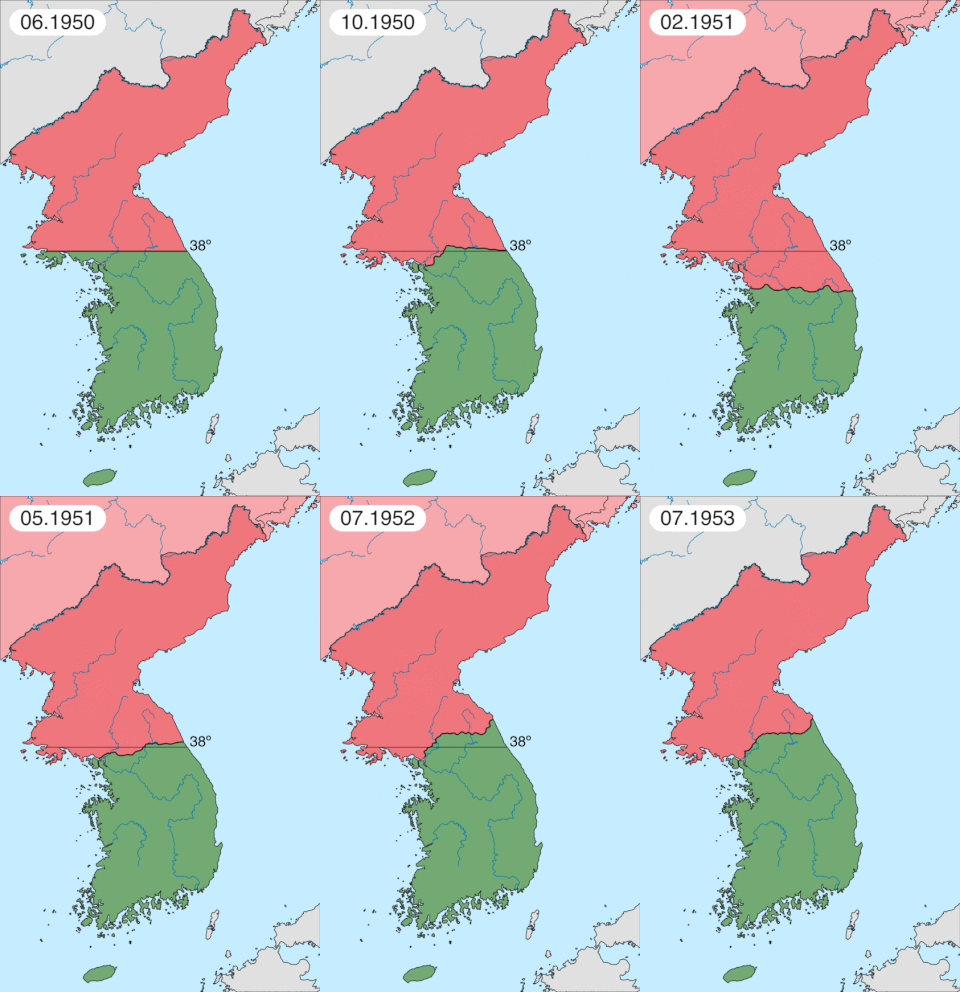
Meanwhile, in South Korea, despite the authoritarian rule of Syngman Rhee and subsequent right-wing governments, a considerable opposition force, including leftists, centrists, and even right-wing opponents of the ruling regime, still existed. Compared to the staunchly right-wing ruling powers, the opposition in South Korea leaned more toward the left. Many opposition figures had deep connections to those persecuted by right-wing governments between 1945 and 1955. Naturally, they harbored strong resentment against the right-wing and, to some extent, held pro-North Korea sentiments.
For example, in 1989, South Korean student leader Im Soo-kyung defied South Korean law to visit North Korea. Upon her return, she was sentenced to prison but showed no regret, reflecting the ideological divide.
From Syngman Rhee to Park Chung-hee and Chun Doo-hwan, South Korea’s ruling right-wing forces long maintained authoritarian control under the banner of “anti-communism.” They brutally suppressed left-wing and centrist democratic opposition, using imprisonment, torture, and executions as political tools. Figures such as Kim Dae-jung were repeatedly imprisoned and sentenced to death. This repression only fueled the opposition’s hatred of the ruling right-wing forces, a sentiment that persists today.
The 1980 Gwangju Democratization Movement and its brutal suppression exemplified the military regime’s violence against left-leaning students and civilians. This event became a symbol of South Korea’s authoritarian repression and left a lasting impact on the nation’s political consciousness.
After democratization in 1987, South Korea transitioned to a more open political system. However, the historical resentment and ideological conflicts between the left and right remained. Not only do the two sides have deep-seated blood feuds, but they also hold fundamentally opposing values and political ideologies.
South Korea’s right-wing conservatives represent the military, elites, and business conglomerates (chaebols) and also enjoy support from conservative rural communities. They advocate low taxes, low welfare, efficiency-first policies, family values, and a competitive individualism. In foreign affairs, they are pro-Japan, pro-U.S., strongly anti-North Korea, and view China with economic cooperation but political and military caution. They strongly reject socialist and communist ideologies.
South Korea’s left-wing progressives focus on workers’ rights, feminism, and social equality, receiving support from students, laborers, women, and intellectuals. They advocate higher taxes, greater welfare, and prioritizing social equality and support for the disadvantaged. In foreign affairs, they harshly criticize Japan’s right-wing and militarist remnants, maintain friendly but cautious relations with the U.S., support closer ties with China, and seek reconciliation with North Korea. They also tend to respect or sympathize with socialist ideologies.
The stark ideological divide and historical animosities have led to extreme political polarization and fierce struggles in democratic South Korea. While political conflicts today are not as bloody as they were during the Korean War or the authoritarian era, modern democracy has provided more avenues for political expression and participation, making left-right confrontations more frequent and diverse in their methods.
Though physical violence has diminished, the battle has shifted to media wars, judicial battles, elections, personnel appointments, strikes, protests, and impeachment efforts. This has created an ongoing cycle of political infighting. Cases such as Roh Moo-hyun’s investigation and death, the imprisonment of Park Geun-hye, Lee Myung-bak, and Cho Kuk, and the corruption scandals involving Kim Dae-jung and Kim Young-sam’s families all involve actual crimes but are also deeply intertwined with political struggles and attacks from opposing factions.
Now, President Yoon Suk-yeol’s alleged attempt to suppress the left-wing opposition through a military coup, the left-wing’s efforts to impeach and arrest him, and the mass protests by both conservative and progressive supporters all reflect the continuation of this historical struggle.
For international observers shocked by the brutality of South Korean politics, understanding the historical context of the Korean Peninsula’s division and the deep-seated left-right animosities since 1945 helps explain the current situation. This also fosters greater understanding—particularly sympathy for the left-wing faction, which has endured severe repression throughout history.
Additionally, flaws in South Korea’s political system—such as excessive presidential powers, a winner-takes-all electoral system, an overly powerful prosecution, and military-intelligence interference in politics—have all contributed to recurring political crises.
While South Korea’s political battles are partly a reflection of democratic engagement, their ongoing intensity is ultimately detrimental to the country’s stability. Given today’s global uncertainties, South Korea also faces domestic crises such as population decline, widening wealth gaps, gender and class conflicts, and rising public anxiety. Under these circumstances, allowing political infighting to persist is unsustainable.
South Korea’s left-wing and right-wing factions, centrists, and international stakeholders should seek ways to reduce political hostility, curb destructive infighting, and promote national unity. Only then can the Korean people—who have endured immense suffering but achieved remarkable success—live in a stable and prosperous society.
 王庆民政治评论